Pet-Friendly National Forests: Off-Leash Dog Guide
Explore the best pet-friendly national forests where dogs can roam off-leash in 2026. Rules, top forests, trail tips, and safety essentials for hiking with dogs.

This post may contain affiliate links. Disclosure
Updated for 2026: USFS regulations, trail access rules, and seasonal restrictions verified for the current year.
If you have spent any time researching where you can actually let your dog run free on public land in the United States, you have probably discovered that national parks are largely a dead end. Most National Park Service trails prohibit dogs entirely, and the ones that allow them require a six-foot leash at all times. National forests, managed by the U.S. Forest Service (USFS), are a different story altogether — and a far better one for dog owners.
The USFS manages 193 million acres across 154 national forests and 20 grasslands. On the vast majority of that land, dogs are welcome. And on most of it — outside of developed recreation areas and interpretive trails — dogs can legally be off-leash, provided they remain under voice control. This is the single most important distinction between national forests and national parks for dog owners, and it changes everything about what a hiking trip with your dog can look like.
Understanding USFS Dog Rules: On-Leash vs. Off-Leash Areas
The baseline USFS regulation is straightforward: pets must be kept on a leash no longer than six feet in developed recreation areas and on interpretive trails. Developed recreation areas include campgrounds, picnic areas, trailhead parking lots, visitor centers, and designated swimming beaches.
Outside of those developed zones — meaning the backcountry, general forest trails, and dispersed camping areas — dogs are generally permitted off-leash as long as they are under control. “Under control” means your dog responds reliably to voice commands, does not chase wildlife, does not approach other hikers or their dogs uninvited, and stays within your sight.
There are important caveats:
- Individual forests can impose stricter rules. Some forests require leashes on all trails during certain seasons (fire season, elk calving, etc.). Always check the specific forest’s regulations before your trip.
- Wilderness areas within national forests may have additional restrictions. Some wilderness areas require leashes; others prohibit dogs entirely.
- State-level regulations can override federal ones. In some states, general leash laws apply even on federal land.
The practical takeaway: national forests offer vastly more off-leash freedom than any other category of public land, but you need to verify the rules for the specific forest and trail you plan to visit.
Best National Forests for Off-Leash Dog Hiking
1. Pisgah National Forest (North Carolina)
Pisgah covers over 500,000 acres in the southern Appalachians, with hundreds of miles of trails through old-growth forests, along rivers, and up to stunning ridge-top views. Most general forest trails allow off-leash hiking with voice-controlled dogs.
The area around Brevard is particularly popular with dog owners. Trails like the Art Loeb Trail and the trails around Looking Glass Rock offer challenging terrain with reliable water sources — something your dog will appreciate on warm days. The Davidson River corridor is excellent for water-loving dogs.
Best season: April through November. Summer temperatures stay moderate at higher elevations.
2. Arapaho and Roosevelt National Forests (Colorado)
Spanning over 1.5 million acres along the Front Range, these connected forests are a backyard playground for Denver and Boulder dog owners. The trail density is remarkable, and the USFS allows off-leash dogs on most backcountry trails.
Popular areas include the Indian Peaks Wilderness (leashes required here), Brainard Lake Recreation Area (leashes required in the developed area, but trails beyond allow off-leash), and the trails around Winter Park and Fraser. The high-altitude meadows above treeline are spectacular for dogs who love to run.
Best season: June through October. Snow can persist on high trails into July.
3. White Mountain National Forest (New Hampshire)
The White Mountains offer some of the most rugged hiking in the eastern United States, and dogs are welcome on nearly all trails. Off-leash hiking is permitted on general forest trails outside of developed areas, though the Appalachian Mountain Club huts do require dogs to be leashed when passing through.
The Franconia Ridge loop, the Presidentials, and the trails around the Kancamagus Highway are all dog-accessible. Be aware that the terrain is rocky and steep — this is serious hiking, and your dog should be in good physical condition. Consider protective hiking boots for dogs on the rougher trails.
Best season: May through October. Fall foliage season (late September through mid-October) is spectacular.

4. Tongass National Forest (Alaska)
The largest national forest in the country at 16.7 million acres, Tongass covers most of southeast Alaska. Dogs are welcome throughout, and the combination of temperate rainforest, glacial valleys, and coastal trails makes it unlike anything in the Lower 48.
The trails around Juneau (Mendenhall Glacier area, Point Retreat Trail) and Ketchikan (Deer Mountain Trail, Rainbird Trail) are excellent with dogs. Wildlife encounters are a real consideration here — bears are common, and off-leash dogs can create dangerous situations. Keep your dog close and carry bear spray.
Best season: May through September.
5. George Washington and Jefferson National Forests (Virginia)
These combined forests stretch along the Blue Ridge and Allegheny Mountains for over 1.8 million acres. The trail system is extensive, well-maintained, and largely uncrowded compared to popular national parks nearby.
The USFS regulations for these forests follow the standard policy: leashes in developed areas, voice control acceptable elsewhere. Trails along the Blue Ridge Parkway corridor, the trails around Mount Rogers (Virginia’s highest point), and the backcountry near Shenandoah Valley are all excellent with dogs.
Best season: March through November. Spring wildflower season is outstanding.
6. Coconino National Forest (Arizona)
Surrounding Sedona and Flagstaff, Coconino offers everything from desert red rock trails to ponderosa pine forests at higher elevations. Dogs are welcome on most trails, with off-leash permitted in general forest areas.
The West Fork of Oak Creek Trail is one of the most scenic hikes in the Southwest, and dogs are allowed (though it gets crowded — early arrival is essential). The trails around Flagstaff, including the Arizona Trail sections through the forest, are excellent for off-leash hiking with fewer crowds.
Best season: October through May for lower elevations; June through October for Flagstaff-area trails.
7. Flathead National Forest (Montana)
Adjacent to Glacier National Park (where dogs are banned from most trails), Flathead National Forest offers a dramatic alternative. Over 2.4 million acres of wild Montana landscape with trails through alpine meadows, along wild rivers, and into the Bob Marshall Wilderness.
Dogs are permitted off-leash on general forest trails, though the Bob Marshall Wilderness requires additional consideration for wildlife protection. Grizzly bear country protocols apply throughout — your dog should be reliable off-leash before you consider it here.
Best season: June through September.
Essential Gear for National Forest Adventures
Hiking in national forests often means remote trails far from services. Pack appropriately for your dog:
- Collapsible water bowl and extra water — Forest streams are common but not guaranteed on every trail
- GPS tracker — Essential for off-leash hiking in dense forest where visual contact can be lost; our review compares battery life and cellular coverage across the top models
- First aid kit — See our pet first aid guide for what to include
- Bear spray — Required in grizzly country (parts of Montana, Wyoming, Idaho, Alaska forests)
- Tick prevention — National forests are prime tick habitat; ensure your dog’s prevention is current. For a comparison of collar, topical, and oral options that hold up during extended outdoor trips, see our best dog flea and tick prevention for travel
- Reflective vest or collar light — For visibility in dense forest and during early/late hikes
- Leash — Even in off-leash areas, carry one for encounters with horses, wildlife, or other dogs

Off-Leash Etiquette and Safety
The freedom national forests provide comes with responsibility. Off-leash privileges on USFS land have faced increasing scrutiny as trail use has grown, and poor behavior from dog owners is the fastest way to lose them.
Voice Control Is Non-Negotiable
If your dog does not have reliable recall — meaning they come back immediately and consistently when called, regardless of distractions — they should not be off-leash on forest trails. This is not about your comfort level; it is about other people’s safety, wildlife protection, and maintaining off-leash access for everyone.
Test your dog’s recall in progressively more distracting environments before relying on it in a national forest. A dog who comes when called in your backyard but ignores you when a deer appears is not under voice control.
Wildlife Interactions
Dogs chasing wildlife is the primary complaint that leads to leash requirements being imposed on previously off-leash trails. The ASPCA and wildlife management agencies consistently cite uncontrolled dogs as a threat to ground-nesting birds, elk calves, deer fawns, and other vulnerable species.
During spring (April through June), many forests implement seasonal leash requirements specifically to protect nesting and calving wildlife. Respect these seasonal restrictions — they exist because the impact is real.
Trail Courtesy
When you encounter other hikers, especially those with dogs, horses, or children, leash your dog temporarily or move to the side and have your dog sit. Not everyone is comfortable with off-leash dogs approaching them, and assuming otherwise is how conflicts start.
Horses in particular are a serious concern on multi-use forest trails. An off-leash dog running at a horse can cause the horse to bolt, potentially injuring the rider. Step well off the trail, leash your dog, and wait for horses to pass.
Leave No Trace
Pack out all dog waste. In the backcountry where packing out is impractical, bury it in a cathole at least six inches deep and 200 feet from water sources, trails, and campsites — the same protocol used for human waste in wilderness areas.
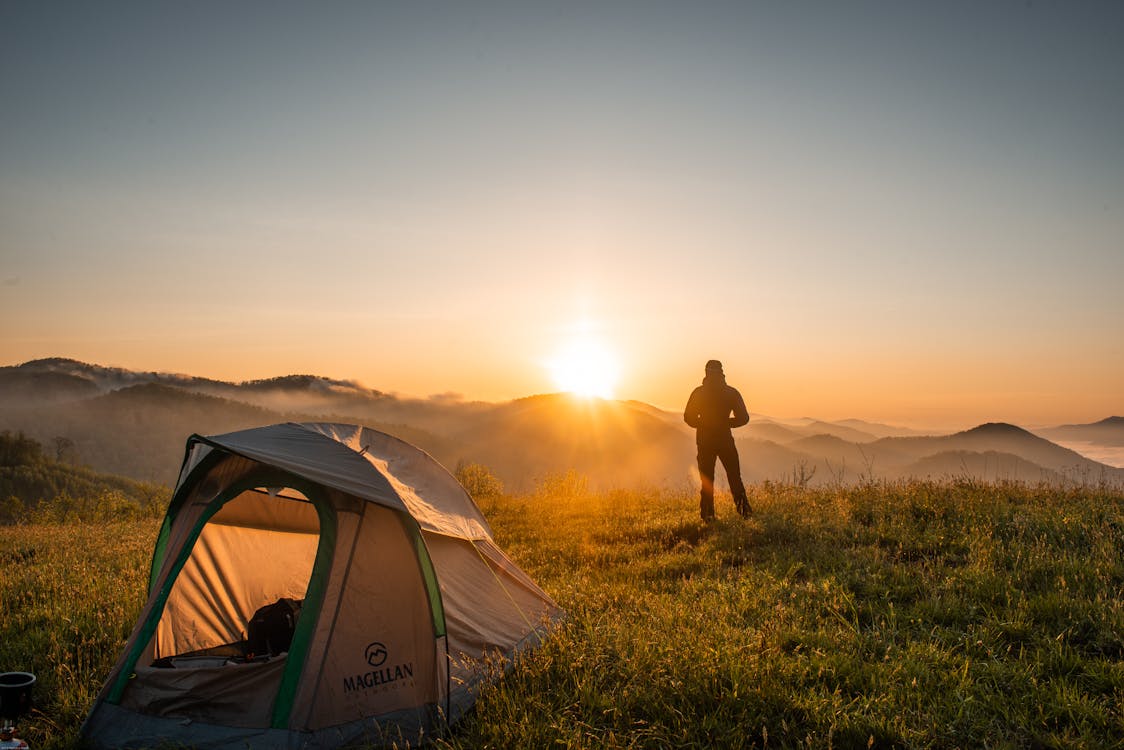
Camping in National Forests with Dogs
National forests offer two types of camping, and both are generally dog-friendly:
Developed Campgrounds
USFS campgrounds allow dogs in virtually all cases. Dogs must be on a six-foot leash at all times in developed campgrounds. Fees range from $10 to $35 per night, and many campgrounds are first-come, first-served.
Dispersed Camping
This is where national forests truly shine for dog owners. Dispersed camping — camping outside of developed campgrounds — is free and permitted throughout most national forest land, typically at least one mile from developed areas and 200 feet from water sources. For a deeper dive on camping logistics, see our camping with dogs guide.
Dispersed camping with an off-leash dog in a quiet forest clearing is one of the best experiences you can have as a dog owner. No neighbors, no leash requirements (outside developed areas), and the kind of freedom that is increasingly rare on public land.
National Forests vs. Other Public Lands
Understanding where national forests fit in the hierarchy of dog-friendliness helps with trip planning:
| Land Type | Dogs Allowed | Off-Leash | Notes |
|---|---|---|---|
| National Forests (USFS) | Nearly all areas | Most backcountry trails | Leash in developed areas |
| BLM Land | Nearly all areas | Generally yes | Similar rules to USFS |
| National Parks (NPS) | Very limited | Almost never | Most trails prohibit dogs |
| State Parks | Varies widely | Rarely | State-by-state rules |
| National Wildlife Refuges | Limited | No | Dogs often prohibited entirely |
For more on navigating national park restrictions with dogs, see our dedicated guide. The short version: if trails and freedom matter to you, national forests are almost always the better choice.
Planning Your National Forest Trip
Finding Dog-Friendly Trails
The USFS website for each individual forest lists trail descriptions and regulations. Cross-reference with AllTrails (filter for dog-friendly) and GoPetFriendly for user reviews from dog owners who have hiked specific trails.
Checking Current Conditions
National forest conditions change with weather, fire, and seasonal closures. Before any trip:
- Check the forest’s website for current trail closures and fire restrictions
- Call the local ranger district office — they are remarkably helpful and can provide current trail conditions and dog-specific information
- Check weather forecasts for the specific elevation you will be hiking
Water and Heat Safety
Many national forest trails are at moderate to high elevation where temperatures can be comfortable even in summer. However, lower-elevation forests (especially in the Southeast and Southwest) can be dangerously hot. Carry at least one liter of water per dog per hour of hiking, and know the signs of heat exhaustion: excessive panting, drooling, lethargy, and disorientation.
Forests to Avoid or Approach with Caution
Not every national forest experience is ideal for dogs:
- Forests with active prescribed burns — Smoke can be dangerous for dogs (and humans). Check fire management schedules.
- Forests with heavy hunting season activity — During deer and elk seasons, bright orange vests are essential for both you and your dog. Some dog owners avoid forest hiking entirely during rifle season.
- Forests with significant grizzly bear populations — Off-leash dogs in grizzly country can provoke charges. If your dog cannot be reliably recalled in the presence of wildlife, leash them.
Making the Most of Your Forest Trip
National forests are the most underrated resource for dog owners in the United States. While national parks get the attention and the crowds, national forests offer more acreage, more trail miles, more camping freedom, and dramatically better dog policies.
The key is preparation. Know the rules for your specific forest, verify your dog’s recall is genuinely reliable before going off-leash, pack appropriate gear including a reliable GPS tracker, and practice good trail etiquette. The reward is access to some of the most beautiful landscapes in the country with your dog running free beside you — an experience that never gets old.
For budget-conscious travelers, national forests are hard to beat. No entrance fees (unlike national parks), free dispersed camping, and trails that rival anything behind a fee gate. Check out our budget pet travel guide for more ways to explore with your dog without breaking the bank.
Get the best Pawventures tips in your inbox
Weekly guides, deals, and insider tips. No spam, unsubscribe anytime.