Best Dog Cooling Vests for Summer Travel 2026 Reviewed
Top-rated cooling vests for dogs on summer trips in 2026. Safety tips, breed-specific risks, and gear picks to keep your pup comfortable in any climate.

This post may contain affiliate links. Disclosure
Summer road trips, beach days, and mountain hikes are a joy for both pet parents and their four-legged companions — but heat can turn adventure into danger fast. At 90 degrees Fahrenheit, asphalt under your dog’s paws can reach 130 degrees or higher — hot enough to cause paw pad burns in under a minute. Dogs regulate temperature almost entirely through panting, so a single piece of well-chosen gear can buy critical time before the next water stop. Brachycephalic breeds like Bulldogs, Pugs, and French Bulldogs face even greater risk — up to 4x the heat stroke likelihood of other breeds, per the AAHA. Below is a practical, fact-checked guide to the best cooling vests for 2026.
Quick answer: Cooling vests protect traveling dogs from heat stroke, a real risk when asphalt hits 130 degrees on a 90-degree day. Evaporative vests like the Ruffwear Swamp Cooler suit dry climates, while phase-change wraps such as the Hurtta Cooling Wrap ECO work better in humidity. Brachycephalic breeds face roughly quadruple the risk.
Why Dogs Overheat on the Road
Heat stress is a combination of temperature, humidity, activity level, and limited airflow — not simply a hot day. According to the AVMA’s Warm Weather Pet Safety guide, dogs regulate temperature mainly through panting and limited sweating through their paw pads. When humidity rises above 70%, the evaporative cooling from panting becomes far less effective, and core temperature can climb rapidly. The CDC’s Extreme Heat Prevention page warns that a car interior can rise nearly 20 degrees Fahrenheit within the first 10 minutes, even with windows cracked — never leave a dog in a parked car in summer.
A dog’s normal body temperature is 101 to 102.5 degrees Fahrenheit. Above 103 degrees is abnormal; above 106 degrees triggers heat stroke and metabolic breakdown; 107 to 109 degrees is life-threatening, according to VCA Animal Hospitals. Signs of overheating include heavy or frantic panting (molars visible), thick ropey drooling, bright-red or grayish-purple gums, vomiting, inability to stand, and in severe cases seizures or collapse. The AKC’s Overheating in Dogs article recommends immediate cooling — moving the dog to shade, offering water, and applying cool (not icy) water to the neck, chest, underarms, groin, and paws. A cooling vest acts as a wearable, constantly moistened heat sink that can delay the onset of heat stroke while you locate a safe spot to rest.
Brachycephalic Breeds: A 4x Higher Risk
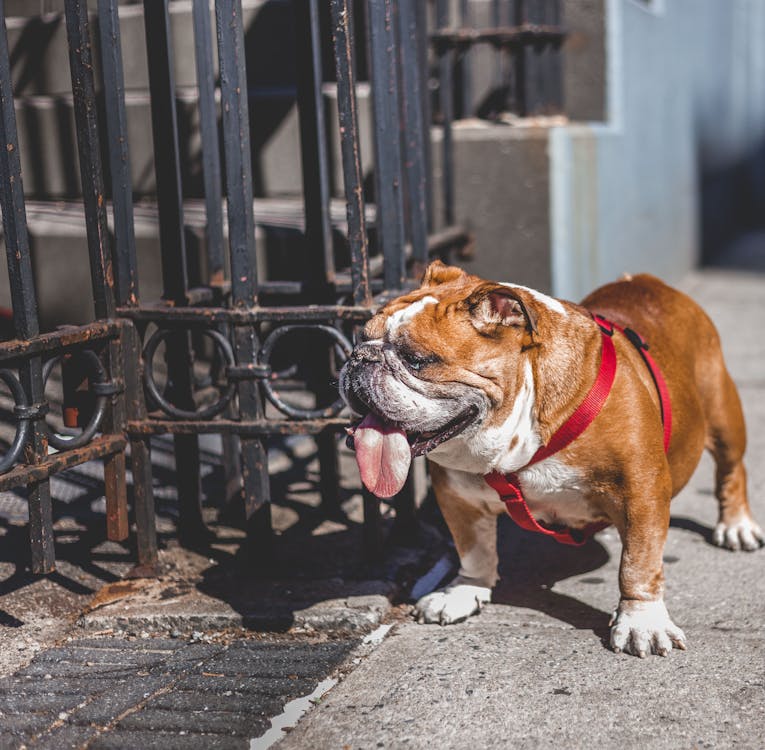
If you travel with an English Bulldog, French Bulldog, Pug, Boston Terrier, Boxer, Shih Tzu, Shar-Pei, Cavalier King Charles Spaniel, Chow Chow, or Bullmastiff, read this section carefully. Brachycephalic (flat-faced) breeds have shortened snouts and narrowed upper airways that reduce panting efficiency — the primary mechanism dogs use to dissipate heat. The result is that these dogs can show heat stroke symptoms after only minutes outdoors in high summer heat. Anything that raises their respiratory demand — heat, excitement, brief exertion — stresses their already restricted airways further.
Practical guidance for brachycephalic owners:
- Walk only during the coolest hours: before 8 am or after 7 pm in summer.
- Limit outdoor time to under 10 to 15 minutes at temperatures above 80 degrees Fahrenheit.
- Prioritize PCM vests (Glacier Tek ChillyDog) or high-retention evaporative vests (HyperKewl, Hurtta) over single-layer mesh options.
- Offer water every 5 to 10 minutes during any outdoor activity.
- Watch for early signs — even a mild increase in panting warrants immediate rest and active cooling.
- If your dog has been diagnosed with brachycephalic obstructive airway syndrome (BOAS), consult your vet before using any cooling vest in extreme heat.
Evaporative vs. Phase-Change: Picking the Right Mechanism
Not all cooling vests work the same way, and choosing the wrong type for your climate can leave your dog dangerously underprotected.
Evaporative vests are soaked in water, wrung out, and worn. As water evaporates from the fabric surface, it draws latent heat away from the dog’s body — the same physics that make you feel cold stepping out of a pool. This mechanism requires two things to work: airflow and low-to-moderate humidity. Below 70% relative humidity, evaporative vests perform well. Above 70 to 80% relative humidity, air saturation slows evaporation and the vest’s cooling effect stalls significantly. This is a critical limitation for Gulf Coast beaches, the Southeast, Florida, and any tropical destination. In those climates, an evaporative vest may give you false confidence.
Phase-change material (PCM) vests work on an entirely different principle. The Glacier Tek ChillyDog, the only PCM option in this roundup, uses solid inserts made from a non-toxic material that absorbs heat as it transitions from solid to liquid, maintaining a consistent 59 degrees Fahrenheit surface temperature. No evaporation is required — the vest is fully effective at any humidity level, making it the correct choice for humid climates. The tradeoff is weight (approximately 4 pounds fully loaded), cost ($139), and the need to pre-freeze packs before each outing.
Summary rule: Dry trail in Arizona? Evaporative vest. Humid beach week in Florida? PCM vest. Mixed itinerary? Bring both types if budget allows, or default to the HyperKewl for its extended 5 to 10 hour duration that reduces mid-outing re-soaking.
How to Size a Cooling Vest Correctly
A vest that is too tight restricts movement and can cause chafing; too loose and it creates gaps where heat penetrates and the cooling surface lifts off the coat. Follow this method for every breed:
- Measure chest girth at the widest point — wrap a soft tape measure around the torso just behind the front legs. This single measurement is the most important sizing input for every vest in this guide.
- Apply the two-finger rule — you should be able to slip two flat fingers between the tape and the dog’s body. Tighter means size up; looser means size down.
- When between sizes, always size up — a slightly looser vest can be adjusted; a too-tight vest cannot be corrected in the field.
- Re-check fit seasonally — dogs gain or lose weight and shed fur, both of which alter how a vest sits.
- Brachycephalic note — barrel-chested breeds (Bulldogs, Boxers) often need one size larger than their weight suggests. Measure chest girth independently of weight charts.
Pavement Burn: The Hidden Summer Danger
A cooling vest protects your dog’s torso, but their paws walk directly on the pavement. At an air temperature of 90 degrees Fahrenheit, asphalt and concrete surfaces can reach 125 to 150 degrees Fahrenheit — hot enough to cause paw pad burns within 60 seconds of contact, according to veterinary heat safety consensus and dvm360. Pavement consistently runs 40 to 60 degrees hotter than the ambient air temperature. A quick test: press the back of your hand against the pavement for 7 seconds. If you cannot hold it there, it is too hot for your dog’s bare paws. Walk on grass where possible, time walks for early morning or after sunset, or use protective booties on extended urban summer outings.
Tips for Using Cooling Vests on the Go
- Pre-soak and pre-freeze early — Soak evaporative vests in cool water for at least 5 minutes, then wring out excess before putting on the dog. PCM packs need at least 4 hours in a standard freezer (or 30 minutes in ice water) before use.
- Know your re-soak window — In direct sun at 90 degrees Fahrenheit, evaporative vests need re-soaking as frequently as every 60 to 90 minutes. In shade at 80 degrees Fahrenheit, 2 to 3 hours is typical. The vest is no longer working when it feels dry to the touch.
- Carry a dedicated water bottle — Vest re-soaking competes with your dog’s drinking water. Pack a separate bottle (at least 16 oz) for gear re-soaking so drinking water is never rationed.
- Rotate PCM packs — For the Glacier Tek ChillyDog, carry a spare set of frozen packs in an insulated bag. Swap without removing the vest to maintain continuous cooling.
- Combine with shade and water breaks — No vest substitutes for stopping activity, finding shade, and offering water every 15 to 20 minutes on hot days.
- Inspect for wear — Mesh tears, broken buckles, or degraded D-rings reduce effectiveness and safety. Check gear before every summer trip.
Product Roundup: Top Cooling Vests for Summer Travel 2026
Below are eight tested and verified vests for 2026, organized from premium evaporative to the only PCM option in the roundup.
Ruffwear Swamp Cooler Evaporative Dog Vest
- ASIN: B01MZ9D28N
- Buy: Amazon
- Price: $56.24 to $74.99
- Best For: Active hiking dogs, multi-hour trail sessions, harness wearers
- Pros: Industry benchmark for evaporative cooling since 2012; three-layer construction (outer air mesh, absorbent felt middle, dry-weave lining) balances UV reflection and water retention better than single-layer rivals; harness-compatible leash portal eliminates gear swaps mid-hike; bluesign-approved fabrics; six sizes from XXSmall (13 to 17 in chest) to XLarge (36 to 42 in chest).
- Cons: Highest MSRP among evaporative options at $75; loses effectiveness above 70 to 80% relative humidity — PCM vest preferred for Gulf Coast or Florida summers; needs re-soaking every 1 to 2 hours on hot dry days.
- Humidity note: Choose the Glacier Tek ChillyDog instead if your trip takes you anywhere with high summer humidity.

Hurtta Cooling Wrap ECO
- ASIN: B08TYV1J1Y
- Buy: Amazon
- Price: $77.00
- Best For: Dogs who overheat at the chest and core; eco-conscious buyers; dogs that resist full-torso vests
- Pros: Wrap design targets chest blood vessels for systemic cooling rather than just surface coverage; recycled bluesign-approved fabrics (60 to 80% recycled content); high-absorption microfiber inner layer holds significantly more water than woven polyester rivals; Finnish performance gear pedigree trusted by sled dog handlers; reviewers report 2 to 4 hours before re-soaking.
- Cons: Most expensive evaporative option at $77; partial coverage provides less UV protection than full-torso vests; limited US retail availability, primarily Amazon and specialty stores.
- Brachycephalic note: Chest-focused wrap is well-suited for flat-faced breeds whose core temperature rises rapidly; choose a size that covers the full ribcage.

RC Pet Products Zephyr Cooling Dog Vest
- ASIN: B07NVJYJNC
- Buy: Amazon
- Price: $21.57 to $28.76
- Best For: Budget-conscious owners, small to medium dogs, casual day trips
- Pros: Best value evaporative vest in this guide at under $22 on sale; seven sizes covering toy breeds through large dogs (XXS at 12 to 15 in chest, XXL at 28 to 40 in chest); lightweight 55% polyester / 45% nylon blend stays functional even when saturated; Canadian brand with consistent quality.
- Cons: Thinner fabric holds less water than triple-layer designs — needs re-soaking more frequently; no integrated leash access point, requires a separate harness; less structured fit can reduce coverage on barrel-chested breeds.
- Humidity note: Effectiveness declines above 70% relative humidity, same as all evaporative vests.

Kurgo Core Cooling Dog Vest
- ASIN: B06WV8JMPQ
- Buy: Amazon
- Price: $44.21
- Best For: Outdoor adventurers who want evaporative cooling plus UV and solar reflection; harness wearers
- Pros: Dual mechanism — evaporative cooling plus heat-reflective outer shell for direct sun exposure; two-way zipper for instant harness or collar access without removing the vest; reflective accents for low-light visibility on dawn and dusk hikes; four sizes cover medium to large breeds (Small: 19 to 27 in, XLarge: 35 to 45 in).
- Cons: Only four sizes — no XXSmall for toy breeds under 15 lbs or coverage for extra-large dogs outside the XLarge range; chest fit runs small, always measure and size up when in doubt.
- Brachycephalic note: Heat-reflective outer layer provides extra benefit for flat-faced breeds exercising in direct sun; size up one for Boxers and Bulldogs.

Frisco Summer UPF 45 Cooling Dog Vest
- ASIN: B0BT5ZT82G
- Buy: Amazon
- Price: $19.00
- Best For: Budget-conscious pet parents, short day trips, dogs sensitive to heavy or structured vests
- Pros: Most affordable quality cooling vest in this roundup at $19; UPF 45+ sun protection blocks up to 98% of UVA/UVB rays — a notable bonus absent in many competitor vests; machine washable; wide size range from XS to XXL.
- Cons: Single-layer breathable mesh holds less water than multi-layer designs and dries faster, requiring more frequent re-soaking; primarily available through Chewy, with variable Amazon stock; less structured fit than premium options.
- Brachycephalic note: A solid budget option for mild heat days; in extreme heat, flat-faced breeds benefit from the multi-layer water retention of the Ruffwear or Hurtta.

HyperKewl Evaporative Cooling Dog Coat
- ASIN: B008MWXMNK
- Buy: Amazon
- Price: $29.95 to $49.95
- Best For: Extended outdoor events, working dogs, dogs in direct sun for multiple hours; owners who want the fewest re-soaks
- Pros: Industry-leading 5 to 10 hour cooling duration per soak — far exceeds standard woven evaporative vests; patented HyperKewl inner fabric absorbs and releases water slowly; brush and burr-resistant outer quilted nylon holds up in scrubby terrain; dry exterior feel reduces dog resistance; trusted by working-dog and service-dog communities.
- Cons: Heavier construction compared to mesh-only vests; XXL required for large breeds — verify chest measurement carefully; effectiveness still reduced above 70 to 80% relative humidity.
- Brachycephalic note: The long cooling duration is particularly valuable for flat-faced breeds who need sustained temperature management without repeated interruptions to re-soak.

Petacc Dog Cooling Vest Outdoor Cooler Harness
- ASIN: B08C22XZC6
- Buy: Amazon
- Price: $22.99 to $29.99
- Best For: Medium-to-large dogs who need a harness-vest combo; urban summer dog walkers; budget buyers
- Pros: 2-in-1 design combines cooling vest with a walking harness and integrated D-ring leash attachment; reflective strips enhance safety during dawn and dusk summer walks; sun-proof outer coating adds UV protection beyond standard mesh vests; under $30 for harness-and-cooling functionality combined.
- Cons: Only two sizes (Medium: 17 to 23 in chest; Large: 22 to 28 in chest) — not suitable for small or extra-large breeds; harness D-ring is not load-tested for pulling or trail use, intended for leash attachment only; lighter mesh requires more frequent re-soaking in extreme heat.
- Brachycephalic note: Convenient for urban flat-faced dog owners who want one piece of gear for quick summer walks, though the two-size limitation may not accommodate all Bulldog body types.
Glacier Tek ChillyDog K-9 Phase-Change Cooling Vest
- ASIN: B0C7SFSF35
- Buy: Amazon
- Price: $139.00
- Best For: Large working and sporting dogs; high-humidity climates (Gulf Coast, Southeast, tropical destinations); dogs who reject wet vests
- Pros: The only PCM vest in this roundup — maintains a consistent 59 degrees Fahrenheit surface temperature regardless of ambient humidity; no evaporation required, making it the correct choice for humid climates where every other vest in this guide will underperform; purpose-built for large working and law enforcement K-9s since 1997; four GlacierPack inserts swap out mid-adventure for extended coverage without removing the vest; dry exterior feel; non-toxic PCM is safe even if a pack is chewed through; packs recharge in 1 hour in a standard freezer.
- Cons: At $139 it is the most expensive option by a significant margin; approximately 4 lbs fully loaded — unsuitable for dogs under 60 lbs; requires pre-freezing packs (at least 4 hours); bulkier profile is less suited for dense brush or narrow trails.
- Brachycephalic note: PCM technology is the single best cooling vest choice for large brachycephalic breeds (Bullmastiffs, Shar-Peis) in humid summer climates where evaporative vests stall. Pre-freeze packs the night before travel.
Maintaining Your Vest for Longevity
- Rinse after use — Rinse off sand, mud, and salt water before machine washing (where the label permits).
- Air-dry fully — Hang in a shaded area; direct sunlight degrades UV-reflective coatings over time.
- Store PCM packs separately — Keep packs in a sealed freezer bag to prevent accidental thawing between trips.
- Inspect seams — Double-stitch seams can split under repeated soaking cycles; repair or replace before heat-related incidents occur.
- Do not tumble dry — Most vests in this guide specify air dry only; dryer heat damages evaporative fabrics and UV coatings.
Final Thoughts: Safety First, Fun Always
Cooling vests are a game-changer for summer travel, but they are one part of a broader heat-management plan. Pair your vest with regular water breaks, shaded rest stops, and a well-stocked pet first-aid kit (see our Dog Road Trip Gear Checklist). No vest replaces attentive monitoring — if your dog shows any signs of heat distress, move to a cooler environment immediately, apply cool (not ice cold) water to the head, underarms, groin, and feet, and seek emergency veterinary care. Happy travels, and may your pup stay cool, safe, and ready for the next adventure.
Related Reading
Get price-drop alerts and new guides from DogTripGuide
One email a week: price drops on the gear we recommend, new guides, and what changed. No spam, unsubscribe anytime.